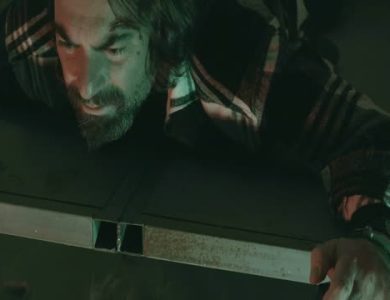
Dead Man’s Wire: A Shotgun, A Wire, and The Longest 63 Hours in Indianapolis History
- Category: Crime, Drama, Thriller, Biography
- Release Date: January 16, 2026 (Wide Release)
- Cast: Bill Skarsgård, Dacre Montgomery, Al Pacino, Colman Domingo, Cary Elwes
- Language: English
- Duration: 1h 45m
- Director: Gus Van Sant
- Screenwriter: Austin Kolodney
The 1970s was a decade defined by anti-establishment rage, economic anxiety, and the golden age of American cinema that reflected these tensions. In 2026, legendary director Gus Van Sant returns to the big screen to channel that specific era of grit and paranoia with Dead Man’s Wire. Based on one of the most bizarre and terrifying hostage situations in American history, the film is a taut, sweaty, and claustrophobic thriller that feels like a spiritual successor to Sidney Lumet’s Dog Day Afternoon.
Anchored by a transformative, live-wire performance from Bill Skarsgård and featuring a supporting cast that includes screen legend Al Pacino, Dead Man’s Wire is not just a reenactment of a crime; it is a character study of a man pushed to the brink by a system he believed was rigged against him. For the audience on fmovies.tr who appreciate true crime stories that prioritize psychological depth over cheap thrills, this is an essential watch to kick off the cinematic year.
The Plot: A Mortgage, A Madman, and a Hostage
The film takes us back to the bitter winter of February 1977 in Indianapolis. Tony Kiritsis (Bill Skarsgård) is a real estate developer who is drowning in debt and consumed by the belief that the Meridian Mortgage Company has cheated him out of his land and his future. Having exhausted his legal options and his patience, Tony decides to take matters into his own hands—literally.
He walks into the office of Richard “Dick” Hall (Dacre Montgomery), a mortgage broker, and initiates a nightmare scenario. Tony isn’t just armed; he has engineered a homemade “dead man’s line.” He wires a sawed-off shotgun to Hall’s neck, with the trigger wire connected to his own neck. The physics of the trap are terrifyingly simple: if the police shoot Tony, or if Tony trips, falls, or dies, the wire pulls taut, and the shotgun blasts Hall.
The Media Circus
What follows is a harrowing 63-hour standoff that spills out of the office and onto the streets. Tony, using his hostage as a human shield, parades Hall through the city, hijacking a police car and eventually barricading himself in his own apartment. The film meticulously chronicles this three-day ordeal.
However, the film is about more than just the mechanics of the kidnapping. It explores the relationship that develops between the captor and the captive. Tony is manic, ranting about conspiracies and demanding a press conference to clear his name. He becomes a folk hero to some—a symbol of the little guy fighting back against the banks. The police, led by negotiators and officers (played by Colman Domingo and others), are rendered helpless by the ingenuity of Tony’s weapon. The climax, a televised press conference where an emotional Tony holds a gun to Hall’s head while the world watches, is one of the most tense sequences filmed in recent memory.
Director’s Vision: Gus Van Sant’s 70s Pastiche
Gus Van Sant is a chameleon of a director, capable of making experimental indies like Elephant and mainstream hits like Good Will Hunting. With Dead Man’s Wire, he adopts a style that feels authentically vintage.
Visual Aesthetic: The film looks like it was found in a time capsule. The cinematography is grainy, utilizing a color palette of muted browns, greys, and ugly office greens. Van Sant captures the bleakness of an Indianapolis winter, where the cold seems to seep through the screen. He utilizes handheld cameras to mirror the erratic, unstable mind of Tony Kiritsis. The editing is sharp, intercutting between the claustrophobic tension of the hostage situation and the chaotic frenzy of the newsrooms covering the event.
The Anti-Hero Narrative: Van Sant walks a fine line. He humanizes Tony without excusing his terror. He presents Kiritsis not as a monster, but as a tragic figure—a man whose valid grievances were twisted by paranoia into violence. The director focuses heavily on the role of the media, suggesting that the cameras fed Tony’s ego and prolonged the standoff, a theme that feels uncomfortably relevant in our modern age of viral fame.
The Cast: Skarsgård’s Tour de Force
While the direction is assured, Dead Man’s Wire lives and dies on the performance of its lead.
- Bill Skarsgård as Tony Kiritsis: This is the performance that will likely define Skarsgård’s career outside of the horror genre. He is unrecognizable. Sporting a balding head, a thick mustache, and a frantic energy, he dominates every frame. He captures Tony’s oscillating moods—from terrifying rage to weeping vulnerability—with frightening precision. It is a loud, physical performance, but Skarsgård finds the quiet moments of despair that make Tony human.
- Dacre Montgomery as Richard Hall: Playing the hostage is a thankless task, but Montgomery (Stranger Things) brings immense depth to the role. He spends the entire movie with a gun barrel pressed against his skull. His performance is one of physical endurance and subtle acting; he conveys terror through his eyes and his breathing. The strange, almost Stockholm Syndrome-like bond he forms with Tony is the emotional anchor of the film.
- Al Pacino: Casting Pacino in a 70s crime drama is a meta-commentary in itself. While his role is supporting, his presence adds a layer of gravitas and connects the film to the cinematic lineage of Dog Day Afternoon. He brings his signature intensity to the proceedings.
- Colman Domingo as Fred Temple: Domingo brings his usual warmth and authority to the role, acting as the audience’s surrogate—the rational voice trying to talk a madman off the ledge.
Critical Review: A Tense Study of American Rage
Dead Man’s Wire has received a Certified Fresh rating, and it is easy to see why. It is a film that grabs you by the throat in the first five minutes and refuses to let go.
The “Network” Influence
Critics have favorably compared the film to Network and The Sugarland Express. The movie is as much a dark comedy about capitalism as it is a thriller. Tony’s rants about mortgages, interest rates, and “the little guy” are delivered with a fervor that is both hilarious and terrifying. The film asks: Is a man with a shotgun crazy, or is the system that drove him to it the real insanity?
Pacing and Structure
At 1 hour and 45 minutes, the film is tight. There is no bloat. Austin Kolodney’s screenplay moves efficiently from the inciting incident to the resolution. The tension comes from the “dead man’s wire” itself. Van Sant constantly frames shots to keep the wire in view, a visual reminder that death is literally one stumble away.
A Few Loose Ends
If there is a criticism, it is that some supporting characters, particularly the family members of the hostage, feel slightly underdeveloped compared to Tony. The film is so focused on Skarsgård’s magnetic performance that everything else occasionally fades into the background. Additionally, some viewers might find the 70s stylization a bit derivative, but for fans of the era, it is a feature, not a bug.
Dead Man’s Wire is a knockout. It is an unpretentious, engrossing, and brilliantly acted piece of cinema. Bill Skarsgård proves he is one of the most fearless actors working today.
For history buffs, it sheds light on a forgotten chapter of American crime. For film lovers, it offers a masterclass in tension. It is a movie that leaves you shaken, reminding us that the line between a citizen and a criminal is sometimes as thin as a piece of wire.